Emergency eyewash stations are an important part of workplace safety, especially in laboratories, manufacturing facilities, workshops, and locations where hazardous chemicals are handled. When an accidental chemical splash occurs, immediate access to suitable flushing equipment can help reduce the risk of serious eye injuries.
However, choosing between a plumbed eyewash station and a portable eyewash station is not always straightforward. Both provide emergency eye flushing, but they differ in water supply, installation, maintenance, and suitability for different workplaces.
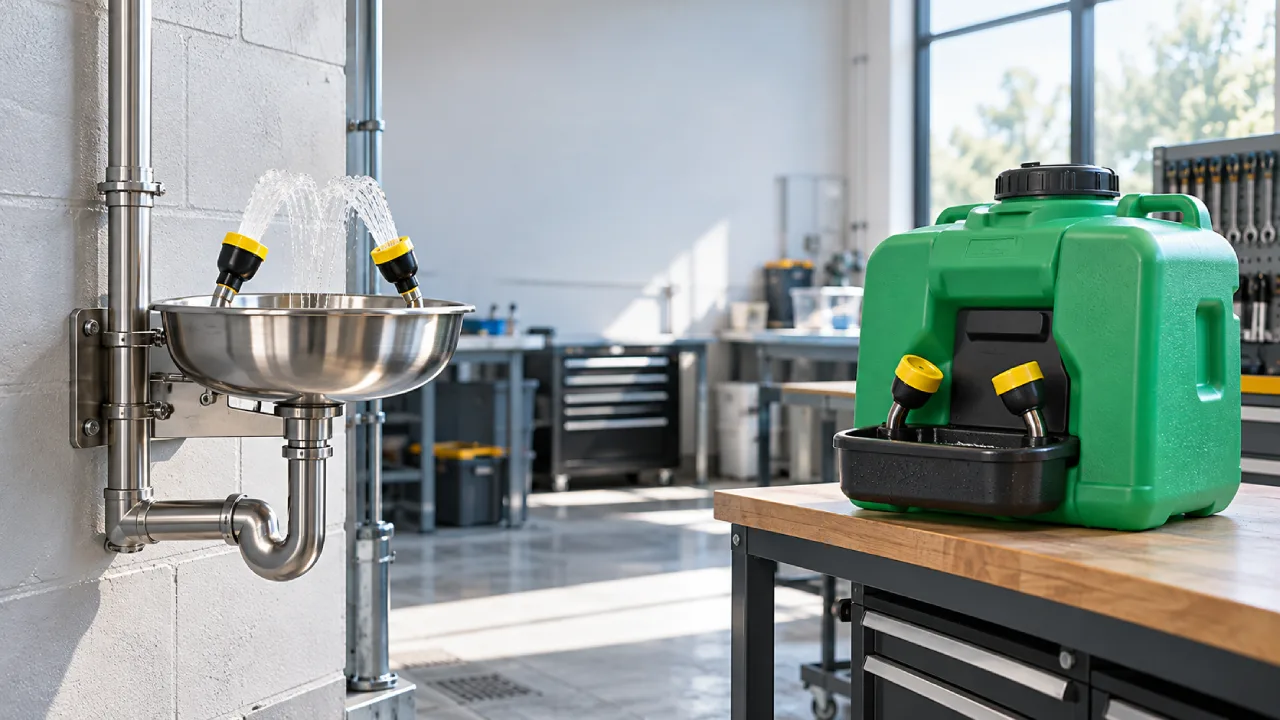
One common question is whether a plumbed eyewash station can be portable. The simple answer is that a traditional plumbed station requires a fixed water connection, while portable eyewash stations use an independent water supply.
This guide explains how both systems work, their key differences, seven essential safety tips, and how to choose the right eyewash equipment for your workplace.
What Is a Plumbed Eyewash Station?
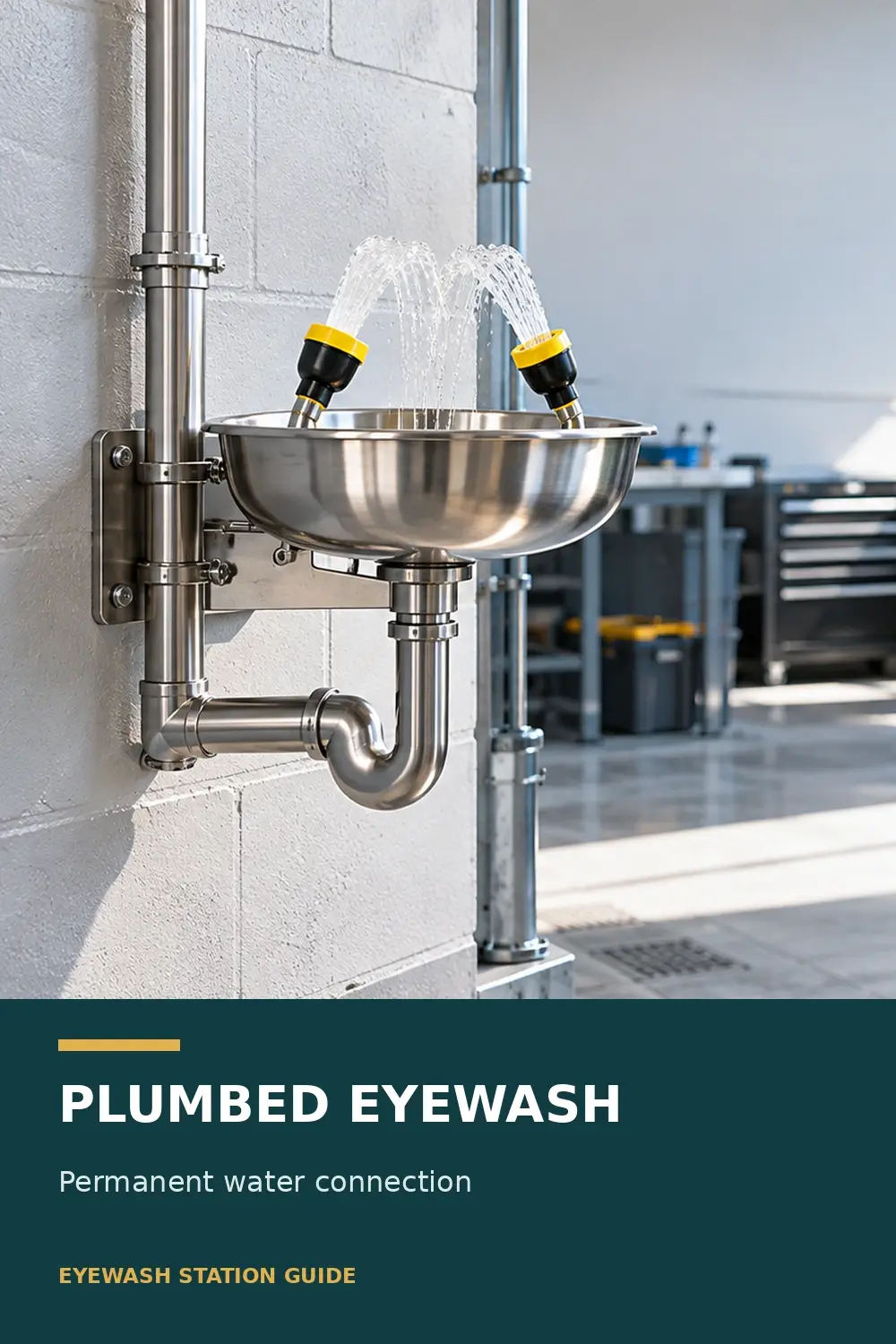
A plumbed eyewash station is an emergency safety fixture permanently connected to a suitable water supply. It is designed to deliver a controlled stream of flushing water to both eyes when someone has been exposed to hazardous substances.
Unlike portable systems, plumbed units do not rely on a limited onboard water tank. Instead, they receive water directly from the building’s plumbing system.
Common configurations include:
- Wall-mounted eyewash stations: Fixed to a wall, making them practical for facilities with limited floor space.
- Pedestal eyewash stations: Freestanding fixtures connected to plumbing, commonly used in industrial environments.
- Countertop eyewash stations: Installed on laboratory counters or work surfaces near potential hazards.
- Combination shower and eyewash stations: Designed for emergency treatment when hazardous substances may affect both the eyes and body.
Plumbed stations are frequently installed in laboratories, chemical-processing facilities, manufacturing plants, and maintenance workshops.
Their main advantage is access to a continuous water supply, provided the facility’s plumbing remains functional and meets the equipment’s performance requirements.
Can a Plumbed Eyewash Station Be Portable?
Technically, a conventional plumbed eyewash station is not portable because it must remain connected to a water supply.
However, portable self-contained eyewash stations can provide comparable emergency flushing performance without permanent plumbing, provided they meet the applicable safety requirements.
Portable eyewash systems generally use stored flushing fluid supplied through gravity-fed or other manufacturer-designed mechanisms.
These systems can be useful in workplaces where fixed plumbing is unavailable or difficult to install.
For example, a temporary construction site may need an emergency eyewash station before permanent water infrastructure is available. A properly selected portable unit may provide a practical solution.
Some portable gravity-fed stations use relatively large water tanks to support the required flushing duration. However, tank capacity alone does not demonstrate compliance. The equipment must provide the appropriate flow, duration, flushing pattern, and fluid quality.
The important distinction is that a portable station is a separate category of equipment rather than simply a plumbed station that has been converted into a movable unit.
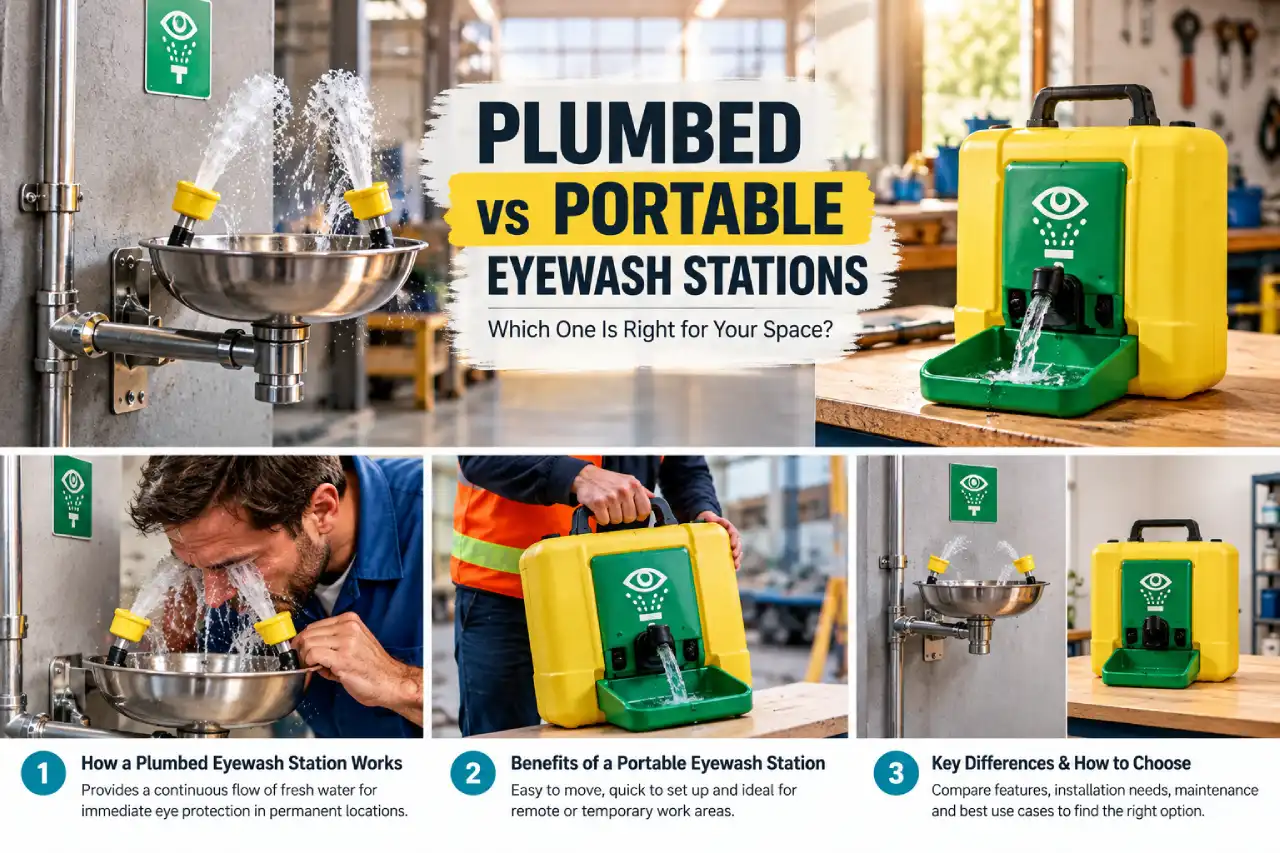
Plumbed vs Portable Eyewash Stations: Key Differences
Understanding the differences between these systems helps businesses choose equipment suited to their working conditions.
| Feature | Plumbed Eyewash Station | Portable Eyewash Station |
|---|---|---|
| Water source | Connected plumbing supply | Built-in fluid reservoir |
| Installation | Requires suitable plumbing | Typically no permanent plumbing |
| Mobility | Fixed location | Can be relocated when appropriate |
| Water availability | Depends on facility water supply | Limited by reservoir capacity |
| Maintenance | Weekly activation and inspection | Fluid checks and manufacturer-required servicing |
| Suitable environments | Permanent workplaces | Temporary, remote, or changing work areas |
| Installation considerations | Plumbing, temperature, and drainage | Placement, fluid storage, and reservoir capacity |
Which Type Is Better?
A plumbed eyewash station is often a practical choice for a permanent facility that has reliable water infrastructure.
Portable eyewash stations may be appropriate for temporary or remote work areas where plumbing is unavailable.
Neither type is automatically safer. The correct choice depends on workplace hazards, equipment performance, location, maintenance, and compliance with applicable requirements.
7 Essential Eyewash Station Safety Tips
Installing an eyewash station is only one part of protecting workers from hazardous exposures. Correct placement, equipment selection, maintenance, and employee training are equally important.
1. Choose a Station That Supports at Least 15 Minutes of Flushing
Emergency eyewash equipment should be capable of providing continuous flushing for at least 15 minutes under ANSI/ISEA Z358.1 guidance.
For dedicated eyewash equipment, the specified minimum total flow is 0.4 gallons per minute (approximately 1.5 liters per minute).
This requirement applies to the overall eyewash flow, not separately to each eye.
The flushing streams must reach both eyes simultaneously at a suitable, non-injurious flow rate.
When comparing portable models, verify the manufacturer’s rated performance rather than relying only on tank capacity.
2. Install Eyewash Stations Within Quick Reach
An emergency eyewash station should be accessible within approximately 10 seconds of the identified hazard under ANSI guidance.
It should generally be located on the same level as the hazard, with a clear and unobstructed route.
Avoid installing emergency eyewash equipment behind locked doors, stored materials, machinery, or obstacles.
Where highly corrosive or unusually dangerous substances are handled, closer placement may be necessary based on a professional hazard assessment.
Clearly visible signs and adequate lighting also help employees locate the equipment quickly.
3. Maintain a Suitable Water Temperature
Flushing fluid that is excessively hot or cold can make emergency treatment more difficult.
ANSI/ISEA guidance defines tepid flushing fluid as approximately 60°F to 100°F (16°C to 38°C).
Temperature-control equipment may be necessary for plumbed stations, especially in buildings where water temperature changes with the seasons.
Portable equipment must also be stored and maintained in conditions that allow it to provide suitable flushing fluid.
A qualified safety professional should assess circumstances where a particular chemical exposure requires additional temperature considerations.
4. Make Sure the Station Allows Hands-Free Operation
During an emergency, the affected person may need both hands to hold their eyelids open.
For this reason, compliant emergency eyewash equipment should feature a stay-open activation valve that allows water to continue flowing without constant manual pressure.
The valve should be simple to operate and capable of activating quickly.
The spray heads must allow simultaneous flushing of both eyes without exposing the user to excessive water pressure.
Protective nozzle covers should also prevent contamination while allowing immediate operation.
5. Inspect and Maintain Eyewash Stations Regularly
An eyewash station can only provide effective emergency protection when it is ready to operate.
Plumbed eyewash stations should be activated at least weekly for a sufficient period to verify operation and help clear stagnant water from the supply line.
Self-contained portable stations require weekly visual checks, including the condition and quantity of flushing fluid.
Additional servicing, cleaning, fluid replacement, or preservative treatment should follow the manufacturer’s instructions.
Maintenance records help businesses identify recurring problems and verify that inspections have taken place.
6. Train Employees to Respond to Eye Emergencies
Even a correctly installed station may be ineffective if workers do not know where it is or how to use it.
Employees working around hazardous substances should receive training covering the location, activation, and correct use of emergency eyewash equipment.
During a chemical eye exposure:
- Immediately begin flushing the affected eyes with suitable flushing fluid.
- Hold the eyelids open and allow the fluid to rinse the eyes thoroughly.
- Remove contact lenses if present and easily removable, without delaying flushing.
- Continue irrigation for at least 15 minutes, or longer when required by the chemical’s safety guidance or medical professionals.
- Arrange prompt emergency medical assessment and follow the chemical’s Safety Data Sheet (SDS) instructions.
Do not rub the eyes or attempt to neutralize an eye chemical exposure with another chemical.
7. Select Equipment Based on Workplace Hazards
Different work environments have different emergency response needs.
For example:
Laboratories: Fixed eyewash stations may be appropriate near chemical-handling benches, while portable solutions may be considered where a suitable fixed installation is unavailable.
Manufacturing facilities: Pedestal-mounted or combination eyewash and shower systems may be required, depending on the substances used.
Temporary construction sites: Portable self-contained equipment may be a practical solution when reliable plumbing is not available.
Chemical storage areas: Emergency equipment placement should reflect the hazard assessment and the possibility of eye or full-body exposure.
Maintenance workshops: Equipment should be positioned where workers can reach it without crossing hazardous work areas.
The final decision should be based on the specific chemical hazards and applicable workplace safety requirements.
How to Install an Emergency Eyewash Station Correctly
Proper installation helps ensure that emergency eyewash equipment is available when needed.
Before installation, carry out a workplace hazard assessment to identify where corrosive or otherwise injurious substances may contact workers’ eyes.
Next, choose a location that offers fast access, suitable visibility, and sufficient clearance around the equipment.
For plumbed stations, verify that the facility’s plumbing can deliver adequate water flow and suitable temperature. Consider drainage, pressure, backflow prevention where required, and the possibility of interruptions in water supply.
For portable stations, confirm that the supporting surface or mounting arrangement is secure, the reservoir is correctly prepared, and the equipment can deliver its rated flushing performance.
After installation, follow the manufacturer’s commissioning instructions and verify that the station operates as intended.
An eyewash station should never be considered fully ready simply because it has been mounted or filled with water.
Weekly Eyewash Station Inspection Checklist
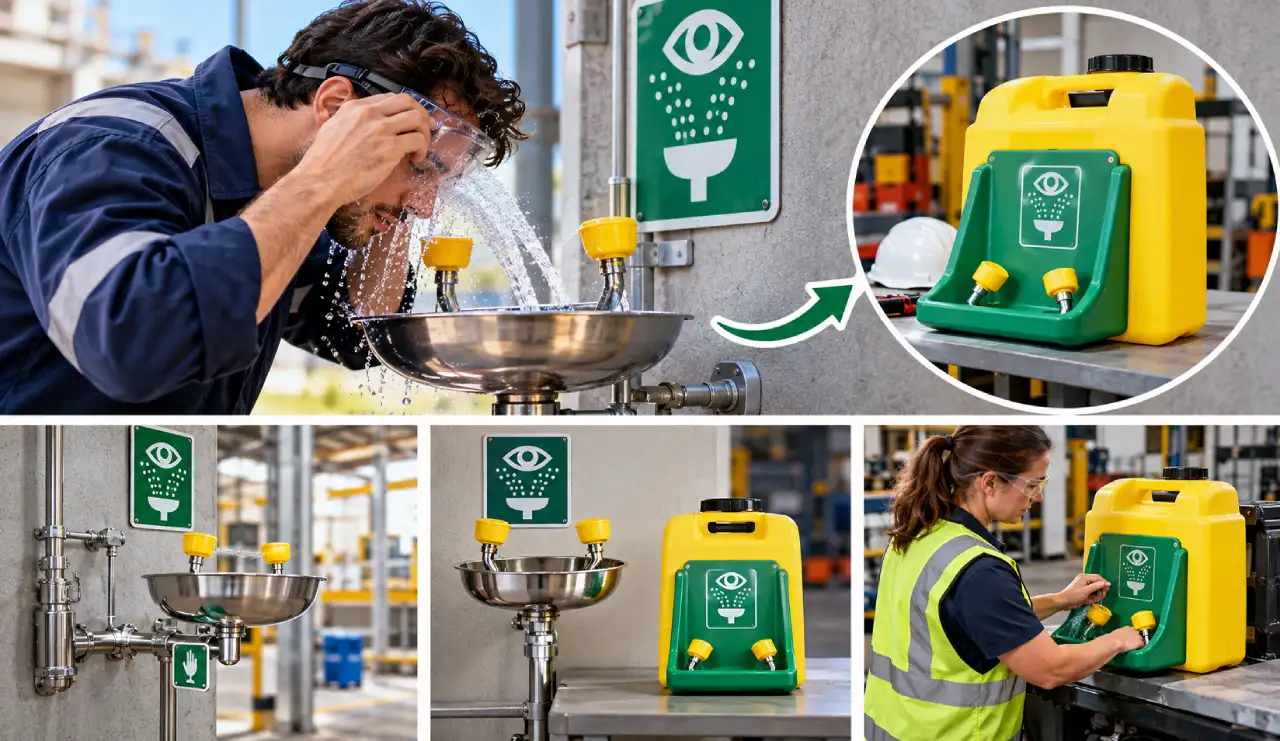
Regular inspections help prevent equipment failures and maintain emergency readiness.
For plumbed eyewash stations:
- Check that the access route is clear.
- Confirm that signs are visible and readable.
- Activate the station and verify that flushing fluid reaches both eyes.
- Inspect spray heads and protective covers.
- Check for leaks, damage, unusual flow, or temperature problems.
- Record the inspection date and any corrective action.
For portable eyewash stations:
- Check the reservoir and flushing-fluid level.
- Inspect fluid condition and expiration or replacement dates where