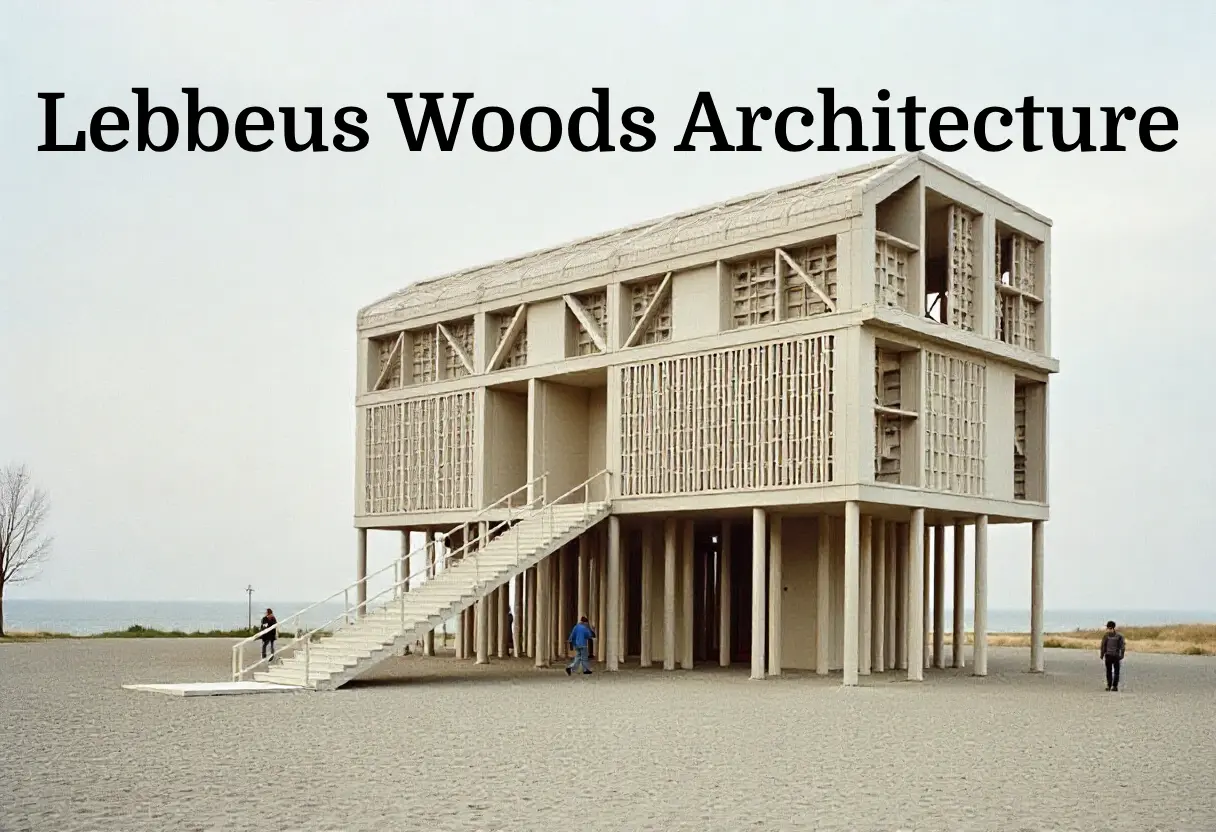
Lebbeus Woods architecture represents experimental design focused on crisis zones, war-damaged cities, and spaces of radical transformation. The American architect (1940-2012) created visionary drawings and theoretical projects that challenged conventional building practices while influencing generations of architects worldwide.
The Architect Who Never Built Buildings
Most architects measure success by the buildings they create. Lebbeus Woods (1940-2012) was an American architect known for experimental and innovative architectural designs, his projects often theorizing architecture in areas experiencing crisis. He built almost nothing. Yet his influence on architecture remains stronger than most architects who filled skylines with steel and glass.
Woods spent his career drawing impossible cities. He sketched structures for war zones, earthquake areas, and places recovering from disaster. His pencil drawings showed twisted metal, fractured spaces, and buildings that seemed to defy physics. These weren’t blueprints for construction. They were ideas given form.
This article explores how lebbeus woods architecture reshaped what it means to be an architect. You’ll discover his most important projects, understand his philosophical approach, and learn why his paper architecture matters more than most built structures.
What Makes Lebbeus Woods Architecture Unique
Architecture as Political Statement
Woods’ work placed architecture back in the realm of buildings, the act of building, and the meaning of actually making buildings. He believed architecture could challenge power structures. His designs asked fundamental questions: Who designs? Who builds? Who owns? Who inhabits?
Traditional architects solve problems for clients. Woods created problems for society to solve. His drawings forced viewers to confront uncomfortable truths about war, disaster, and inequality.
The Freespace Concept
Woods developed the idea of freespace—architecture without predetermined function. He proposed construction of spaces of extreme conditions of living and dwelling for ones who abolish conventional principles of architecture. These spaces had no set purpose. Inhabitants would define their own uses.
Think of it as the opposite of a corporate office. Every room in an office building has a designated function. Woods imagined spaces where people could create their own meanings, free from architectural tyranny.
Drawing as Building
For Woods, the act of articulating ideas graphically or through the medium of the model—of releasing those ideas from the realm of the mind into the real world—is as constitutive of building as is the act of physical construction. He didn’t see his unbuilt projects as failures. Drawing was the architecture.
This philosophy liberated Woods from commercial constraints. He could explore radical ideas without worrying about budgets, building codes, or client demands.
Major Projects and Concepts
War and Architecture
Woods witnessed the Bosnian War firsthand. The experience transformed his work. He created reconstruction proposals for Sarajevo and Zagreb that didn’t erase war damage. Instead, his designs incorporated destruction into new structures.
He was commissioned to prepare a design for the reconstruction of the Electrical Management Building in Sarajevo. His design depicted a self-created space from the ashes of an unsuccessful and calamitous past. The building would acknowledge trauma rather than hide it.
Berlin Free-Zone
In 1990s Berlin, Woods envisioned construction of an underground community along the U-Bahn lines. His goal was to encourage citizens of Berlin to reconnect their own city and their fragmented culture. The project remained on paper but influenced how architects think about divided cities.
San Francisco Earthquake Project
Woods created “Inhabiting the Quake” for San Francisco. The project imagined buildings that could move during earthquakes. These weren’t conventional seismic designs. They were structures that accepted instability as a design feature.
The Light Pavilion: His Only Built Work
He designed a light pavilion in the Sliced Porosity Block, Chengdu, China with Steven Holl. Completed shortly before his death in 2012, the pavilion consists of angled metal beams creating an abstract space within a commercial development.
Woods described the Pavilion as a space designed to expand the scope and depth of our experiences. That is its sole purpose, its only function. Even in his single built project, Woods prioritized experience over utility.
The Lebbeus Woods Philosophy
| Core Principle | Explanation | Impact on Practice |
|---|---|---|
| Architecture as resistance | Buildings should challenge power, not serve it | Created designs for crisis zones |
| Indeterminate space | Spaces without fixed function empower users | Developed freespace concept |
| Drawing as architecture | Ideas matter more than construction | Focused on theoretical projects |
| Crisis as opportunity | Disaster reveals architectural potential | Worked in war zones, earthquake areas |
| User as creator | Inhabitants should shape their spaces | Rejected conventional building types |
Transforming the Individual
In his visionary world, architecture instrumentalizes continuous transformation of the human being as its user who becomes its creator, giving it meaning and content through their way of acting in space. Woods believed buildings should change people, not just house them.
This radical humanism set Woods apart from other experimental architects. He cared deeply about how spaces affected human consciousness.
Beyond Building Types
Hospitals look like hospitals. Schools look like schools. Woods rejected this typology. He wanted buildings that defied categorization. The architect who designs building non types, or else the freespace of unknown purpose and meaning, inverts the pyramid and creates new building types.
Influence on Contemporary Architecture
The Teaching Legacy
Woods was a professor of architecture at the Cooper Union in New York City and at the European Graduate School in Saas-Fee, Switzerland. His students spread his ideas throughout the profession.
The opening of his exhibition included a conversation between Southern California architects Thom Mayne and Neil Denari, who remembered Woods as a mentor and friend. Major architects acknowledge his influence.
Impact on Zaha Hadid
Zaha Hadid, the architect who designed the Michigan State University museum, was a longtime friend and colleague of Lebbeus Woods. Each architect contributed tremendously towards a burgeoning experimental architecture discourse, and Hadid has spoken publicly of Woods’s impact and influence on her practice.
Woods showed Hadid and others that architecture could be about ideas, not just buildings.
The Digital Age Connection
Woods worked before widespread digital tools. Yet his complex geometries and non-rectilinear forms predicted computational design. Younger architects use parametric modeling to achieve effects Woods drew by hand.
His emphasis on process over product also resonates with contemporary practice. Architecture studios now value research and speculation alongside construction.
Understanding Woods Through His Writings
Woods maintained a blog from 2007 to 2012. These posts offered unfiltered access to his thinking. The blog includes characteristically enigmatic illustrations including experimental inhabited structures over Paris and an undulating landscape of slum-like dwellings in the Korean Demilitarized Zone.
His writings criticized mainstream practice. He called Frank Gehry “the undisputed master in our time of architectural styling”—not a compliment from Woods. He wanted architecture that illuminated human conditions, not just impressive forms.
The blog posts, collected in “Slow Manifesto,” reveal an architect constantly questioning assumptions. Woods never settled into comfortable positions.
The Exhibitions and Recognition
Museum Collections
Woods’s works are held in collections of major museums internationally, including MoMA, the Whitney, MAK Vienna, and the Getty Research Institute. Art museums embraced Woods when architecture museums hesitated.
Major Retrospectives
An exhibition of Woods’ work, including his drawings, was organized by the San Francisco Museum of Modern Art in 2013. This posthumous show traveled to multiple venues, cementing his reputation.
The Drawing Center in New York presented his work specifically as drawing art. Museums recognized what the construction industry couldn’t: Woods’s value lay in his ideas.
Awards and Honors
Woods was a 1994 recipient of the Chrysler Design Award. The award recognized design excellence, not built work. Woods proved architecture could exist outside traditional practice.
Common Questions About Lebbeus Woods Architecture
Why didn’t Woods build more? Woods chose not to build. He believed drawing allowed more freedom to explore radical ideas. Commercial architecture required compromises he wouldn’t make.
Was Woods against all built architecture? No. Woods critiqued architecture that served power without questioning it. He supported buildings that challenged conventions and empowered users.
How can architects apply Woods’s ideas today? Consider who benefits from design decisions. Create spaces that allow multiple uses. Question whether conventional building types serve their intended users.
What’s the difference between Woods and other paper architects? Woods had explicit political goals. His projects responded to specific crises. Other paper architects explored form without Woods’s social commitment.
Did Woods influence video games or science fiction? Yes. His drawings influenced dystopian aesthetics in films and games. The movie “12 Monkeys” used designs similar to Woods’s work, leading to a legal settlement.
The Lasting Impact
Woods was considered by many to be the conscience of the architectural profession. He kept architects honest. While others chased commissions, Woods asked whether buildings made the world better.
His death in 2012 coincided with Hurricane Sandy flooding New York. The timing felt symbolic. No architect had devoted more energy to the consequences of catastrophic urban failure than Woods.
Lessons for Today’s Architects
Woods showed that architecture extends beyond building. His career proves several truths:
You don’t need construction to contribute to architecture. Woods influenced the field through drawings, writings, and teaching. Ideas shape practice as much as buildings.
Architecture should serve people, not power. Woods consistently challenged who architecture benefits. His questions remain relevant as cities grow more unequal.
Crisis reveals architectural potential. Woods worked where others feared to go. War zones and disaster areas showed him what architecture could become.
Experimentation matters. Without Woods pushing boundaries, architecture becomes conservative. His willingness to explore impossible ideas opened space for others.
Continuing the Conversation
Lebbeus Woods architecture represents a path not taken by most architects. He chose ideas over income, drawings over construction, questions over answers. His unbuilt projects matter more than many built buildings.
Woods proved architecture exists in the mind before it exists in the world. By rejecting conventional practice, he created a new model. Not every architect needs to build. Some architects serve the profession better by thinking, teaching, and drawing.
The question Woods left behind: What would happen if we lived by different rules? His drawings suggested possibilities. The buildings don’t exist. The ideas endure.
That may be Woods’s greatest achievement. He built nothing and changed everything.