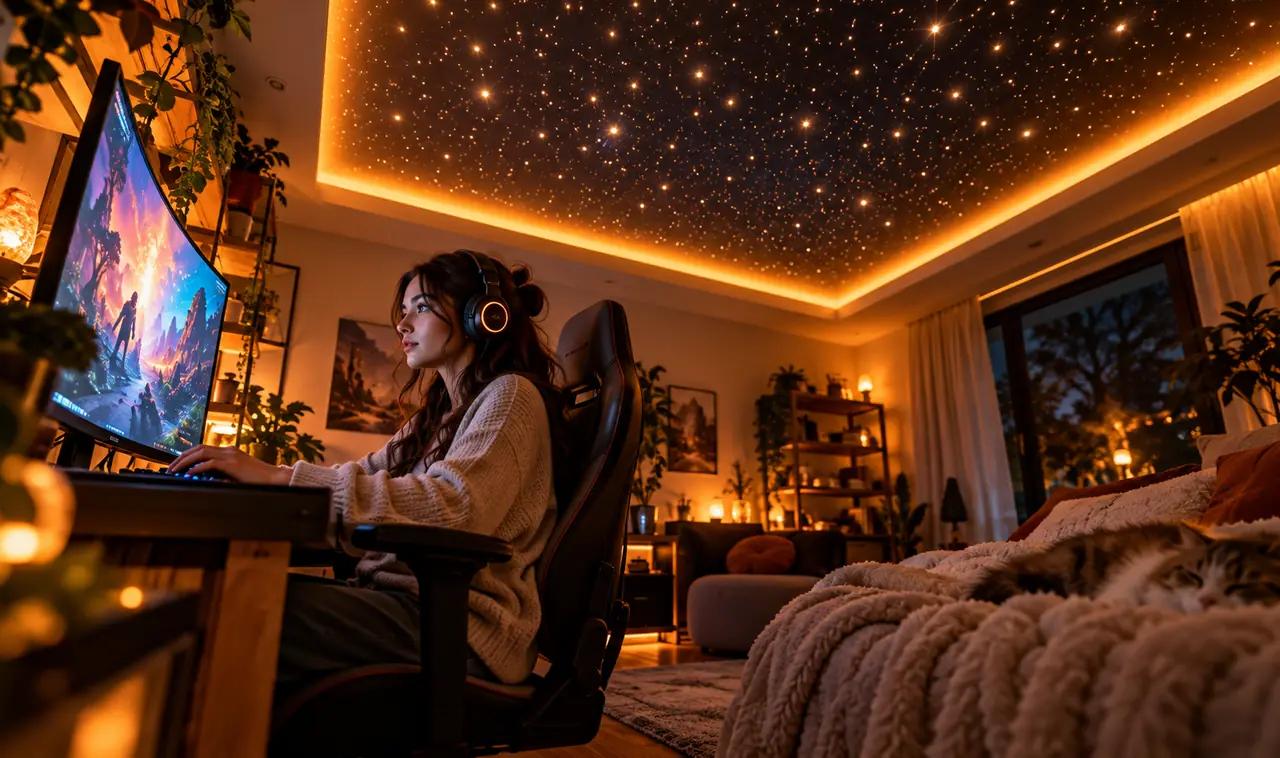
Most gaming rooms get planned from the floor up. Desk, chair, shelves, posters, done. Then you lean back during a loading screen and stare at a plain white ceiling that does not match any of it.
That blank fifth wall is why a room with great gear can still feel unfinished. It also does real work. The ceiling decides how light spreads, how much your voice echoes on chat, and how hot the air gets.
The good news is that none of this needs a renovation budget. Some fixes below cost less than a new game. Others are honest weekend projects.
One quick check first: look at what is already above you. Renters, low ceilings, and sloped attic roofs each rule out a few options, Here are 17 gaming room ceiling ideas that hold up in real rooms.
1. A Fiber Optic Star Ceiling That Twinkles Over Your Chair
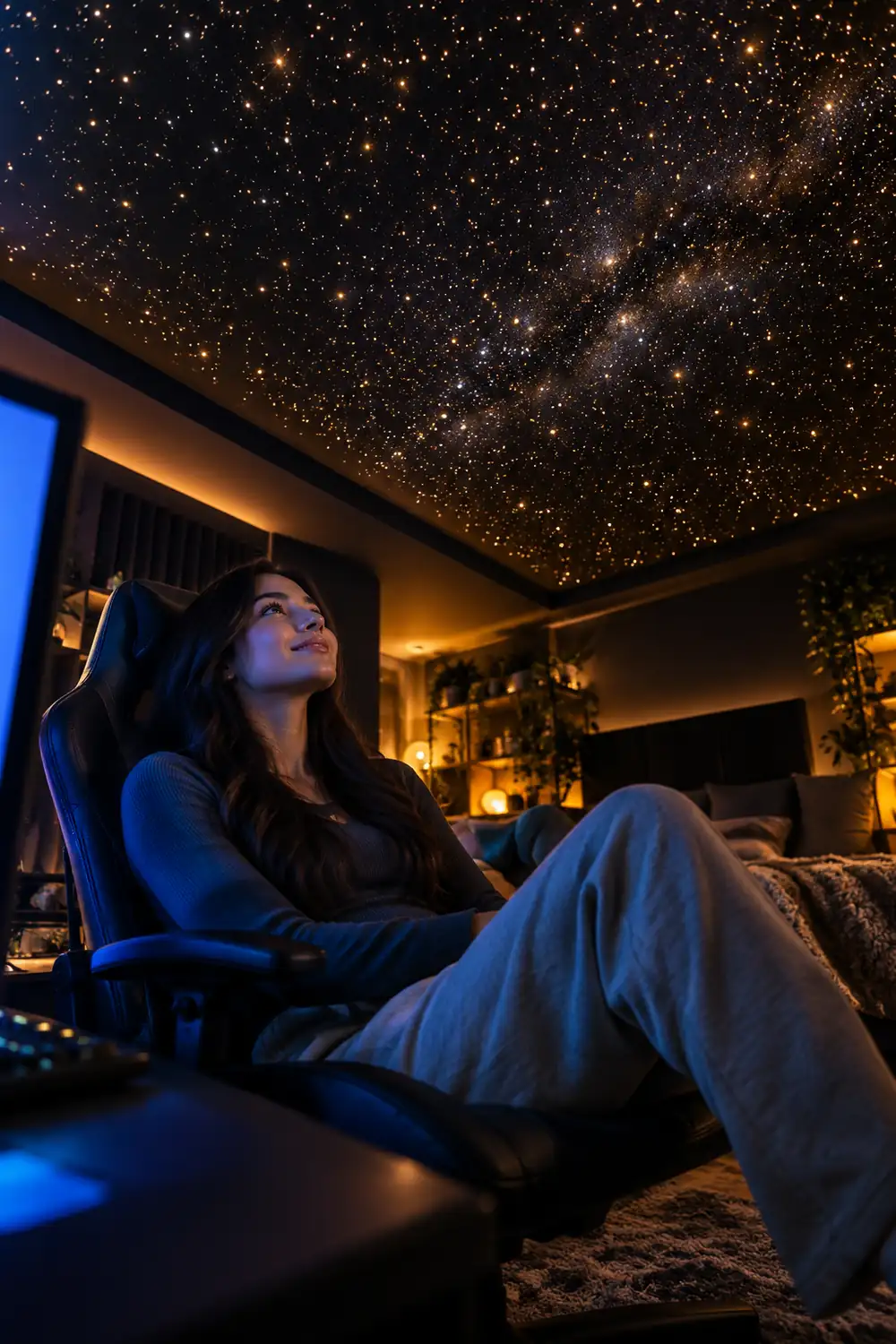
The first time the lights go down, this one stops conversation.
A fiber optic kit threads hundreds of thin strands through the ceiling, all fed by one small light engine tucked in a corner. Set the engine to a slow twinkle, because a steady glow looks flat within a week. A shooting star add-on sounds gimmicky until one crosses mid match.
Renters should skip the drilling. Mount the strands in a framed panel and hang it like art above the desk. The panel leaves with you.
2. LED Cove Lighting Hidden in a Perimeter Tray
Direct ceiling light is harsh on tired eyes. A cove sends it the long way around.
Mount a shallow tray or crown ledge a few inches below the ceiling line and lay an LED strip inside it, facing up. The light washes across the ceiling and spills down the walls, so nothing points straight at your screen. Color changing strips are the same hardware used in most RGB gaming room ideas, so one remote can run the whole room.
💡 Quick Tip
Keep the strip at least two inches from the wall inside the tray. Closer than that, you get a hard bright line instead of a soft wash.
3. Matte Black or Deep Navy Paint for a Cinema Ceiling
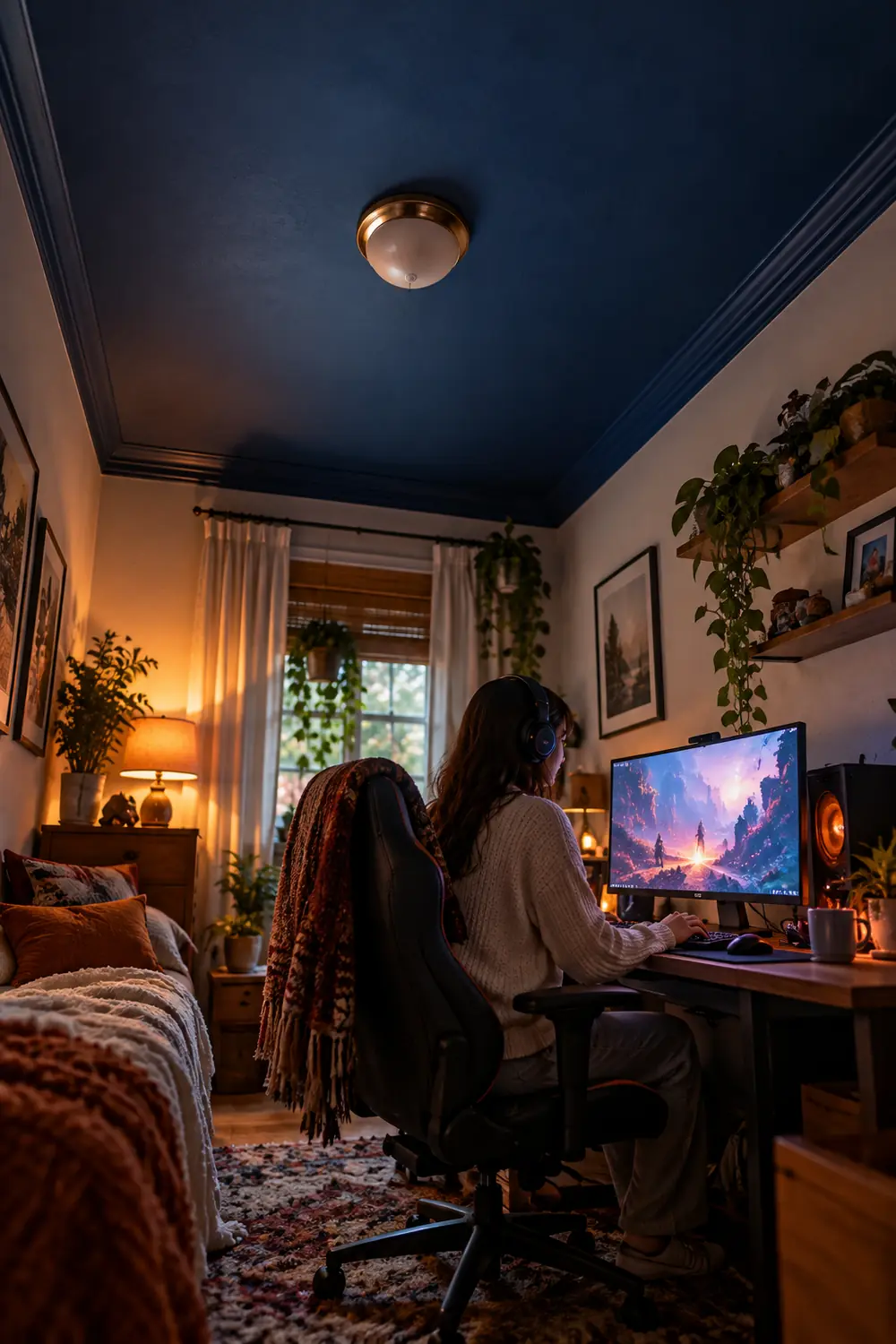
Paint is the cheapest ceiling job on this list, and for movie style rooms it might be the best.
A flat black or deep navy ceiling swallows stray monitor glow instead of bouncing it back at the screen. The room feels lower in a good way, like a small theater. Use a true matte finish, because eggshell and satin show every roller line once the lights drop.
Two honest warnings. Dark paint shrinks a room that is already low. Check your height first. Renters should ask the landlord, or save this one for a house.
4. Acoustic Ceiling Panels in a Loose Checker Pattern
Echo is a ceiling problem before it is a microphone problem.
Fabric wrapped or foam panels mounted overhead catch the first bounce of your voice, the bounce your teammates hear as a hollow room sound. A checker layout with real gaps between panels sounds nearly as good as full coverage and looks like a design choice.
What to grab first
Start over the desk only. Most rooms never need a second row.
5. Faux Beams With Light Strips Tucked Along the Edge
Beams give a flat ceiling a skeleton.
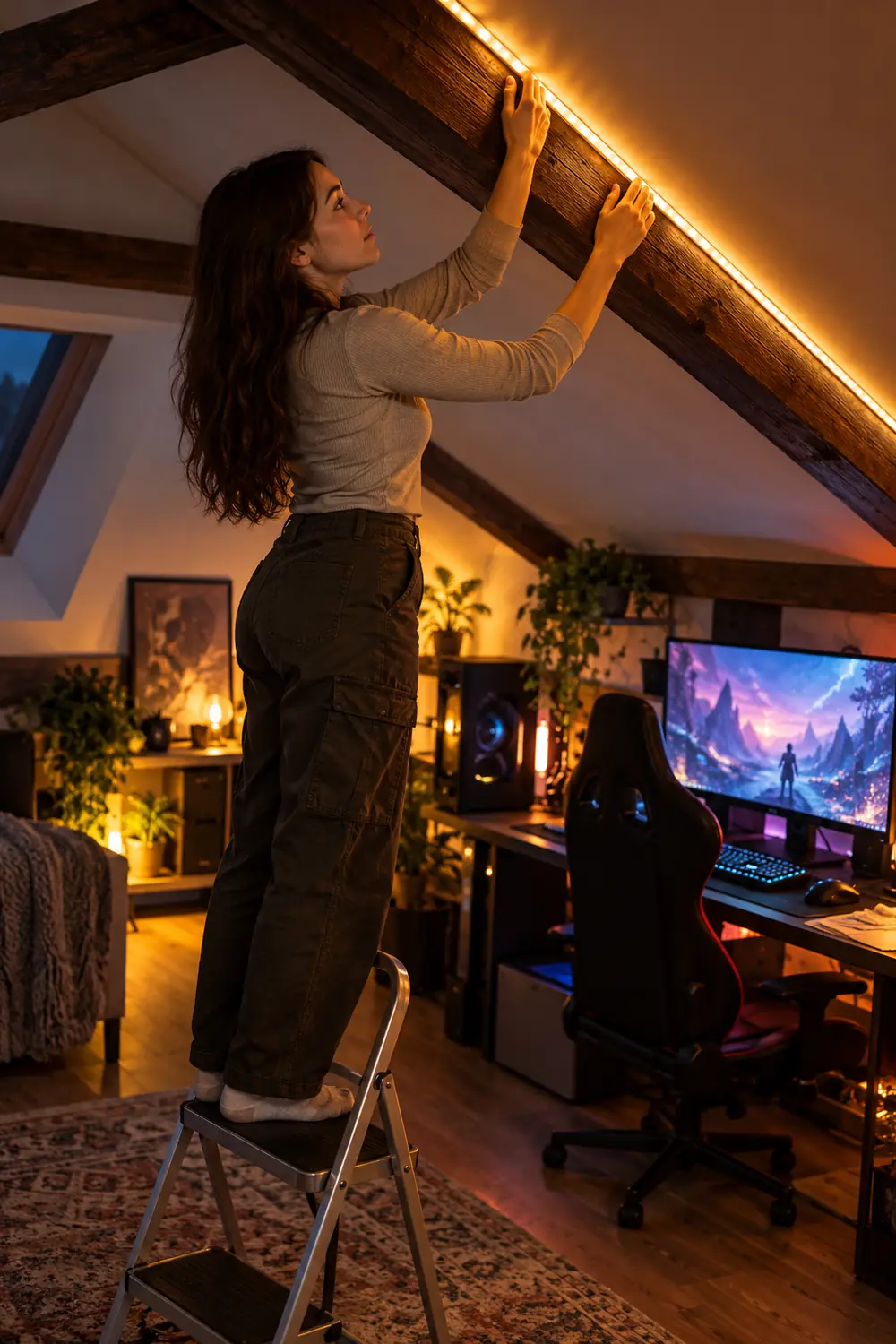
Hollow foam beams weigh almost nothing and glue or screw up in an afternoon. Run a warm LED strip along the inner edge of each beam and the ceiling gains depth without losing an inch of headroom to a fixture. Sloped roofs were made for this treatment, and it anchors most attic gaming room ideas for exactly that reason.
Paint the beams one shade darker than the ceiling. Same color reads as trim. Darker reads as structure.
6. Modular Hexagon LED Panels Over the Desk
Snap together light tiles belong on the ceiling more than on a wall.
Hexagon panels clicked into a honeycomb over your chair throw bright, even light with no lamp taking up desk space. Start with six to nine tiles. More than that and the ceiling starts to feel like a trade show booth.
Put them on a dimmer or app schedule. At full brightness they are work lights. Dropped low and warm during a late session, they become the room’s mood instead of its glare.
7. A Cloud Ceiling With Color Changing LEDs Behind It
Storm clouds on the ceiling sound like a joke until the room goes purple at dusk.
Panels or boards covered in polyester fill hang just below the ceiling, with LED strips running behind them. The light diffuses through the fill, so the clouds glow from inside and shift color by scene. A slow purple storm during a story game is the setting everyone lands on.
Safety, plainly: LED strips only, since they run cool. Keep fill away from any hot light, and never cover a smoke alarm.

8. Pressed Tin Look Tiles in a Dark Finish
Popcorn ceilings are the strongest argument for tiles ever made.
Foam and PVC tiles molded with a pressed tin pattern glue straight over a rough ceiling, no scraping, no dust storm. A charcoal or aged copper finish suits a gaming room far better than the bright white these tiles usually ship in.
| Foam tiles | PVC tiles |
|---|---|
| Lightest option, kind to old plaster | Heavier, sharper pattern detail |
| Cuts with a utility knife | Needs tin snips or a fine saw |
| Best for renters and quick covers | Best for a long term, solid feel |
Order one extra tile. Corner cuts are where beginners lose material.
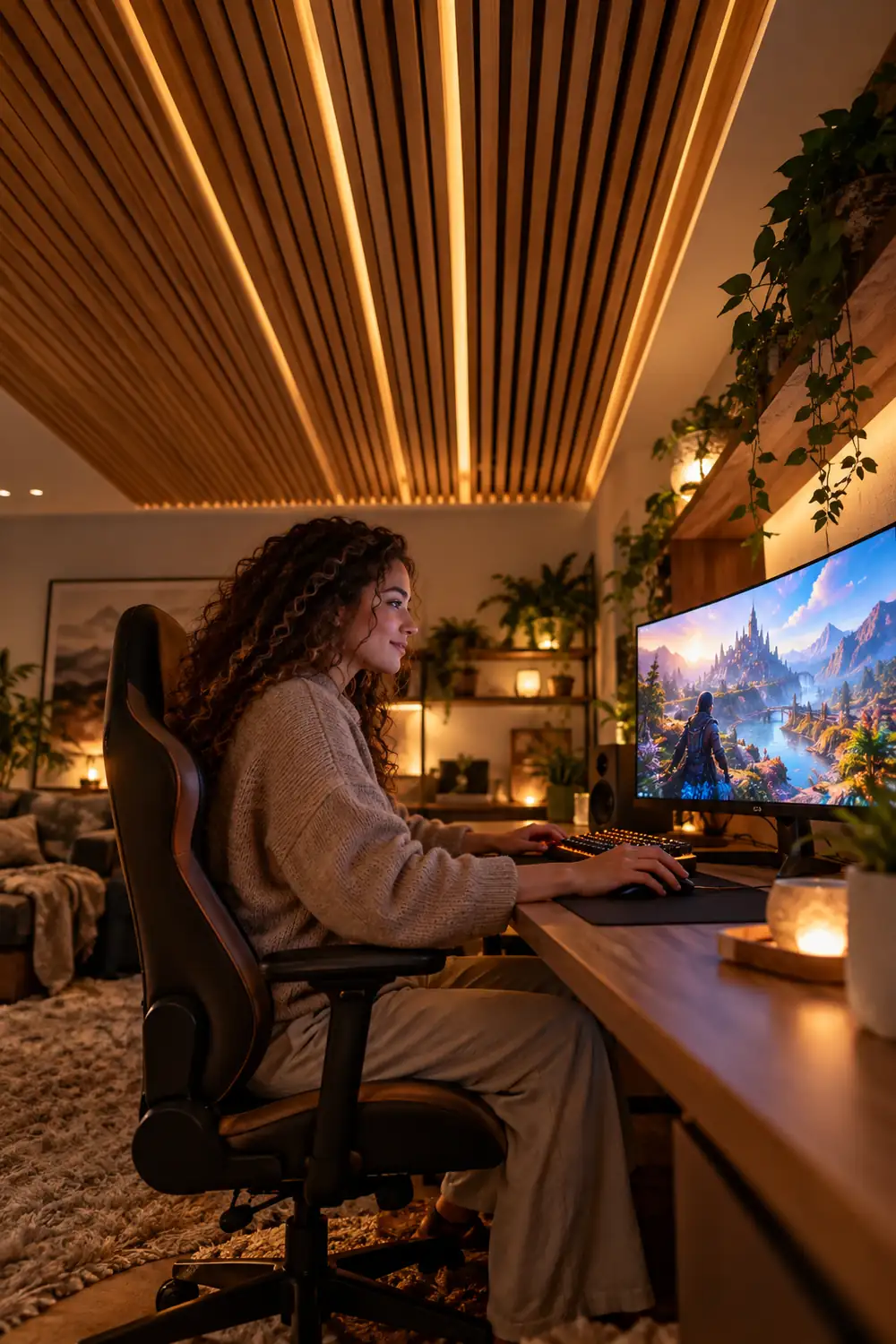
9. Warm Wood Slat Panels That Kill the Echo
Cold rooms often are not cold. They just sound and look hard.
Wood slat panels, real veneer or printed MDF, warm a ceiling the way a rug warms a floor. The grooves also break up sound, so a slatted section over the desk pulls double duty. Run the slats the long way and a short room feels longer.
Budget version that works: panel only the zone above your setup. Wipe the grooves monthly, because dust shows on wood faster than on paint.
10. A Backlit Lightbox Panel Like a Soft Skylight
Windowless rooms have a ceiling problem nobody talks about: there is no sky.
A framed panel with an LED sheet behind a white diffuser fixes that feeling in one fixture. Set it to a daylight tone while you work, then warm it down at night when the games start. It is the closest thing to a skylight an interior room can get.
Placement matters more than brightness. Center it over the seating, not the monitor. Light reflected in the screen is a smudge you will chase for months.
11. Glow Stars With a Projector Wash for Game Nights
The cheapest idea in this article still earns its spot.
Flat glow in the dark stars, the small dot kind, charge under normal room light and fade slowly after lights out. Keep them in rough constellation clusters over the couch corner. Scattered evenly across the whole ceiling, they read as a child’s room. Clustered, they read as a sky.
Add a small galaxy projector for game nights only. The moving nebula wash turns the plain ceiling into a slow light show, and it stays off on work nights.
12. Hanging Acoustic Baffles Over the Battle Station
Flat panels treat a wall. Baffles treat the air.
Acoustic panels hung on short cables, a few inches below the ceiling, catch sound from both sides, and a slight angle breaks up echo better than a flush mount. Hang them over the desk, where your voice and keyboard actually live, not across the whole room.
Two practical notes. Find a joist before you trust any anchor. A baffle over your head is no place to test drywall plugs. Keep the drop shallow: six inches of air gap does the work without making the ceiling feel like it is falling in.
13. Smart Recessed Lights Split Into Two Zones
One bright ceiling light for a whole gaming room is like one volume setting for a whole house.
Slim recessed lights on two separate dimmers, one zone over the desk and one over the couch, let the room change jobs. Full light for cleaning. Desk zone low for play. Couch zone only for films.
Map the zones on paper first, desk side and lounge side.
Keep every bulb the same color temperature so zones blend.
Save three scenes: clean, play, and film. One tap each.
Keep any downlight from sitting directly over the monitor. That placement mistake puts a bright spot on the screen no setting can fix.
14. A Low Profile Ceiling Fan Light for Hot Rooms
Heat rises, and in a small gaming room it rises straight into the air you breathe.
A flush mount fan light moves that air back down and earns its place twice, once as a fan and once as the room’s main light. It pairs well with the other gaming room cooling ideas that deal with PC and console heat at desk level.
Buy the version with separate fan and light controls, and use the balance kit in the box. A wobbling fan over a gaming chair goes from charming to impossible in about one session.
15. A Draped Fabric Canopy for a Lounge Corner
Not every ceiling fix is hardware.
Light fabric swagged from a center hook, falling in soft panels toward the walls, turns a boxy room into something that feels like a tent at a night market. Gauze and thin cotton work best, and they do not trap heat the way heavy drapes do.
Keep it to a corner if the full ceiling feels like too much. Above a couch, the canopy marks the lounge zone without a wall. Choose washable fabric. Ceiling dust is real, and the first wash will prove it.
16. A Drop Ceiling With Flat LED Panels in the Basement
Basement ceilings come with pipes, ducts, and exactly zero charm.
A grid ceiling hides the mess while keeping it reachable. Swap two plain tiles for flat LED panels and the room gets bright, even light with no fixtures hanging down. Painting the grid black or charcoal stops it from looking like an office.
In a basement, treat the ceiling as a tool, not a lid: keep access to the pipes open, and let flat panels do the lighting.
Lift a tile before every plumbing job and you will never regret choosing a grid.
17. A Satin or Gloss Finish That Bounces the Glow
Here is the counter move to the dark ceiling in idea three.
A satin or soft gloss finish reflects the light you already own. RGB strips, monitor glow, a lamp in the corner, all of it spreads further, and a low ceiling reads a few inches taller. Metallic paint in a muted bronze or pewter does the same trick with more character.
Honesty section: gloss shows every flaw in the drywall under it, every seam and patch. On a rough ceiling, satin is the safe middle ground. Test one patch above the door for a week, then commit.
Start smaller than your ambition. One coat of paint, one strip of light, one panel over the desk, and the room already feels different. Gaming room ceiling ideas reward that slow order, because you see the ceiling in every break and every loading screen. Pick the idea that fixes what bothers you most, heat, echo, glare, or plain boredom, and let the rest wait for another weekend. Save this list for the next time you look up and see a blank white rectangle staring back.